
If an adult tooth has just been knocked out, stop reading in a second and go do step one. The window on saving that tooth is measured in minutes, not hours.
Wayne Kye, DDS, MS, FACD, FICD
Periodontics and Implant Dentistry. Diplomate of the American Board of Periodontology. Clinical Associate Professor at NYU College of Dentistry.
Front tooth injuries almost never happen at a convenient time. A pile up in a rugby game. A fall. An e-bike that stops faster than the person on it. We have treated all three.
What happens in the next hour matters more than almost anything we do afterward, so here is the short version first.
If the tooth was knocked completely out
This applies to adult teeth. Baby teeth are different and we cover those below.
- Find the tooth and pick it up by the crown, the part you normally chew with. Do not touch the root. The cells on the root surface are what allow the tooth to reattach, and wiping them off is what usually kills the tooth.
- If it is visibly dirty, rinse it briefly with milk or saline. Do not scrub it, do not use soap, and do not dry it off.
- If you can, put it straight back into the socket the right way round, and bite gently on a clean cloth or gauze to hold it there. This is the single best thing you can do.
- If you cannot reimplant it, put it in a cup of milk. Milk keeps the root cells alive far better than water does. Your own saliva is second best, and a tooth preservation solution is ideal if you happen to have one.
- Never store it in plain water. Water destroys the root cells quickly.
- Get to a dentist immediately. Call us on the way. Your odds are best within the first 30 to 60 minutes.
Our main line is 212-679-4300, and calls are accepted 24 hours. Say the words knocked out tooth and you will not be put in a queue.
Handle it by the crown, keep it wet, and get here fast. Those three things decide most of it.
If it is a baby tooth
Do not try to put a knocked out baby tooth back in. Reimplanting it can damage the adult tooth developing above it. Keep your child calm, control any bleeding with gentle pressure on the socket, and call a dentist the same day so it can be checked.
If it is chipped or cracked rather than knocked out
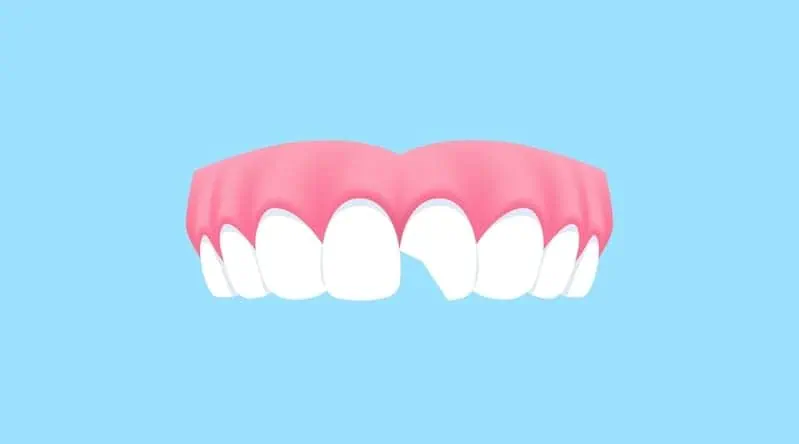
Save any fragment you can find and put it in milk, the same as above. We can sometimes bond the original piece back on, which is the best possible color match because it is the actual tooth.
Rinse your mouth gently with warm water, use a cold compress on the lip or cheek to keep swelling down, and stay off very hot or very cold food and drink until you are seen.
Do not assume a small chip is a small problem. What matters is not how much tooth you can see missing, it is how close the damage came to the nerve. A chip that looks minor can still expose the pulp, and pain that starts a day or two later is a signal worth taking seriously.
What happens once you get here
We examine the tooth and the ones either side of it, since teeth next to an injury are frequently damaged too. We take digital X-rays to check the root for fractures and to look at the surrounding bone, which is the part you cannot see and the part that determines your options later.
If the tooth was reimplanted, we splint it to the neighboring teeth so it can stabilize. From there it depends on what the exam shows. Small chips are often handled with bonding in one visit. Larger damage may need a veneer or a crown. If the nerve dies, which is common after a hard impact, the tooth needs a root canal to be kept. If it genuinely cannot be saved, a dental implant replaces it.
Why the follow up appointments matter
This is the part people skip once the emergency has passed and everything looks fine again.
A tooth that took a hard knock can lose its nerve supply months later, and the first sign is often the tooth slowly turning gray. Caught early, that is a manageable problem. Left alone, it can become an infection at the root tip. We monitor injured teeth on a schedule for exactly this reason, and it is worth keeping those appointments even when nothing hurts.
One of our patients had been coming in for routine checkups for seventeen years before an e-bike accident took out a front tooth and chipped others. Over the following year he had root canals, implants, and crowns. You can see that case, along with a rugby injury and a few others, on our before and after cases page.
Common questions
Can a knocked out tooth really be put back?
Often, yes, if it is an adult tooth and it gets back into the socket quickly. The root surface cells are the limiting factor, which is why handling and storage matter so much.
How long do I have?
Treat it as an emergency and aim for the first 30 to 60 minutes. Chances drop the longer the tooth is out of the socket and dry.
Can I put the tooth in water?
No. Plain water damages the root cells quickly. Milk is the easiest good option, and your own saliva works in a pinch.
Should I go to an emergency room instead?
If there is a head injury, a possible broken jaw, or bleeding you cannot control, go to the emergency room first. For the tooth itself, a dental office is the right place, and calling ahead means we can be ready for you.
Save our number in your phone now, before you need it. 212-679-4300, answered 24 hours. We see patients at Rockefeller Center and Grand Central.
This article is general first aid and treatment information, not a diagnosis or a treatment recommendation, and it is not a substitute for being seen. If you have a head injury, a suspected fracture, or bleeding you cannot control, seek emergency medical care first. Results shown on our before and after cases page are of actual patients of the practice, and individual results vary.