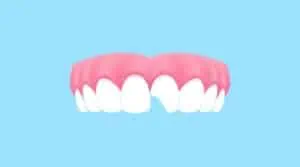

You broke one front tooth. The one next to it is perfectly healthy. What happens next is where a lot of dental offices quietly make a decision on your behalf.
Here is the situation we see constantly. Somebody chips, cracks, or discolors one of their two upper front teeth. The other one is fine. Nothing wrong with it at all.
And then they get told they need to do both.
There is a real reason behind that recommendation, and it is not always dishonest. But it is worth understanding what you are agreeing to, because the price of it is a healthy tooth.
Two is easier than one
If we make two new crowns or two new veneers, they only have to match each other. They come out of the same lab, on the same day, from the same batch of
porcelain, built by the same technician. Getting them to agree is not hard.
Matching one new tooth to one natural tooth is a completely different job. Now the target is something nature made, and nature did not make it a single color.
So when an office suggests doing both, they are often solving their own problem rather than yours. It is the easier path, and it costs you a healthy tooth that gets cut down to make room for a restoration it never needed.
It is widely considered the hardest thing to do in dentistry.
That is exactly why we think a practice should be able to do it.
What makes a natural tooth so hard to copy
Pick up a mirror and look closely at one of your front teeth in daylight. It is not one color. It is usually darker and more saturated near the gum, lighter through the middle, and noticeably more translucent at the biting edge, where you can almost see through it. Some people have faint white spots or thin vertical lines. Most people have subtle surface texture that catches light in a specific way.
On top of all that, gum tissue color shows through near the base, and older restorations with metal underneath can cast a gray shadow into the gum itself.
Copying that with a flat, evenly colored piece of porcelain is how you end up with the tooth everyone notices. Too white, too opaque, too perfect. It reads as fake precisely because it is too consistent.
How we actually do it
For most of the history of dentistry, shade matching meant a dentist holding a tab of plastic teeth next to your mouth and picking the closest one. That is one person’s judgment, under whatever light happens to be in the room, described in words to a technician who has never seen your face.
Our answer is not a better gadget. The naked eye is still the best judge of color there is, and no device reads a tooth quite the way a trained eye does. So instead of trying to replace the eye, we get the right eye in front of you.
That means the ceramist. The person who actually builds your restoration matters more than any tool in the room, and we work with a world class one. For a single front tooth, our ceramist will come to the office, look at your tooth in person, and take their own photographs. If it suits you better the other way round, we can send you over instead. They are in Midtown, a few minutes from both of our offices.
Photography does the rest. Good clinical images capture the surface texture, the translucency at the biting edge, and the small characteristics that make your tooth specifically yours, and they go straight to the person building the restoration rather than through a written description.
Digital shade matching is still an option if you want it. It measures the tooth in hue, value, and chroma, the three parameters of the Munsell color system, and turns color into numbers instead of opinions. Ask us and we will arrange it. You can read more about color matching on our color matching page.
What this means for you
It means the conversation changes. Instead of deciding whether to sacrifice a healthy tooth for the sake of symmetry, the question becomes which single restoration is right for the damaged one. Sometimes that is a porcelain veneer. Sometimes the tooth has lost too much structure and needs a crown. Sometimes a small chip only needs bonding and you are out in one visit.
What it should not mean is drilling down a tooth that had nothing wrong with it.
A few of these from our own case files
One patient came to us after a veneer done at another office broke. We replaced it with a single crown and matched it to the natural tooth beside it. Another patient had a long night in Jamaica, fell out of bed, and damaged one upper front tooth. As we put it at the time, nobody ever has to know.
A third was replacing an old porcelain fused to metal crown on the upper right central incisor, which adds the extra problem of the metal underneath graying out the gumline. Size, shape, tooth color, and gum color all had to be solved together.
All three are on our before and after cases page with photographs, so you can judge the results yourself rather than take our word for it.
Common questions
Can you really match just one front tooth?
Yes. We do it routinely. It takes good photography, a ceramist who will look at your tooth in person rather than work from a description, and the patience to get it right, but it is very much possible.
Do I have to crown both front teeth so they match?
Not with us, in most cases. There are situations where treating both is genuinely the right call, usually when both teeth already have significant damage or old restorations. But we will tell you why, and we will not recommend it simply because it is easier to match.
Will the new tooth stay matched over time?
Porcelain does not stain the way natural enamel does, so over many years your natural teeth can drift while the restoration stays put. If you are planning to whiten, whiten first and match afterward. We will talk you through the order at your consultation.
How many visits does it take?
That depends on what the tooth needs. Bonding is often a single visit. A veneer or crown usually means a preparation appointment, a temporary, and a fitting appointment once the lab work is back.
If you have one front tooth you have been unhappy with, bring it in and let us look at it. We see patients at Rockefeller Center and Grand Central, and a consultation is a conversation, not a commitment.
Book a consultation.
This article is general information about treatment options, not a diagnosis or a treatment recommendation. What is right for your tooth depends on an examination. Results shown on our before and after cases page are of actual patients of the practice, and individual results vary.