
In our experience, parents arrive more nervous than their kids do. Which makes sense, because you know what a dental visit feels like and your toddler has no idea yet.
Tracy Kim, DMD
Board Certified Pediatric Dentist
Let us take the mystery out of it. Here is exactly what a first visit looks like at SLim Dental Kids, start to finish.
When to come the first time
The guidance from the American Academy of Pediatric Dentistry and the American Dental Association is the same: by your child’s first birthday, or within six months of the first tooth coming through, whichever happens first.
That surprises a lot of parents. One tooth hardly seems worth an appointment.
But the first visit is not really about finding cavities. It is about starting early enough that nothing has gone wrong yet. We look at how the teeth are coming through, check for the very first signs of early decay, and talk with you about the things that actually cause problems in toddlers: bottles at bedtime, sippy cups of juice all afternoon, and how to brush teeth belonging to someone who would rather you did not.
It is also about the room. A child who has been here three times before anything needed doing is a completely different patient than a child whose first visit is the one where something hurts.
What the visit actually looks like
For babies and young toddlers we often do a knee to knee exam. You sit facing one of our team, your child sits on your lap facing you, and then lies back with their head in our lap. Your child can see you the whole time and you are holding onto them the whole time. It takes about a minute.
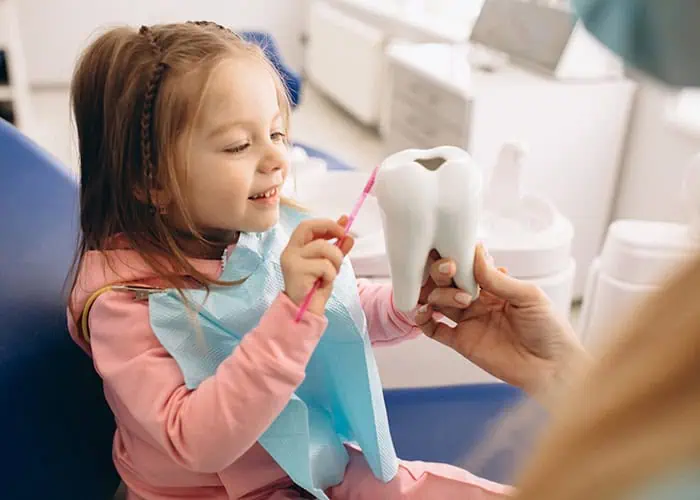
For older toddlers and preschoolers, it is usually a ride in the big chair, which most of them enjoy more than the exam itself.
Then we count the teeth, look at the gums and the bite, and give a gentle polish if your child is up for it. We may apply fluoride varnish, which is quick and tastes fine. We look at the tongue and the way the mouth is working. And we spend a good chunk of the visit talking to you, because at this age the home routine is doing most of the work.
We are not trying to get through a checklist. We are trying to make sure your child leaves willing to come back.
What we do not do
And if your child has a hard day, we stop. Some kids sit there delighted. Some cry the whole time. Some will not open their mouth at all, and that is genuinely fine. A short visit that ends well is worth much more to us than a complete exam that ends badly.
How to get your child ready
A few things help:
- Book a morning slot if you can, after a nap and a snack. A tired hungry toddler is a different person.
- Keep it light and matter of fact at home. Read a picture book about going to the dentist if you have one.
- Let them bring a favorite toy or blanket.
- Talk about counting teeth and getting them shiny rather than about being brave.
And a few things that backfire, even though every parent means well by them:
- Do not say it will not hurt. Your child had not thought about hurting until you brought it up.
- Do not promise there will be no shots. That is a promise you cannot guarantee, and breaking it costs you their trust for years.
- Do not share your own bad dentist stories where they can hear you. Kids pick up far more than we give them credit for.
After the first visit
Most children come back every six months. As the permanent molars arrive, usually around age six, we will talk about sealants, which protect the grooved chewing surfaces where most childhood cavities start. Beyond that it is the unglamorous prevention work, and it is the part that decides how the next ten years go.
Common questions
What age should the first visit be?
By the first birthday, or within six months of the first tooth appearing. If your child is older than that and has not been seen yet, that is completely normal and we are glad you are booking now.
Will my child need X-rays?
Usually not at a first visit for a very young child. We take X-rays when there is a reason to, such as teeth that touch each other closely enough that we cannot see between them.
What if my child cries the whole time?
We do what we can, and we try again next time. It is a normal reaction at this age and it is not a problem for us.
Do you take our insurance?
We participate with most major PPO dental plans. Call the office with your plan details and we will check before you come in.
What if my child needs treatment and cannot sit still for it?
We offer sedation options, including nitrous oxide, for children who need help getting through a procedure. We also offer IV and general anesthesia sedation with our medical anesthesiologist.
We are on York Avenue on the Upper East Side, and we would love to meet your little one. Call us at 646-762-0256 or email kids@slimdental.com.
This article is general information for parents, not a diagnosis or a treatment recommendation. Every child is different, and what is right for yours depends on an examination.